
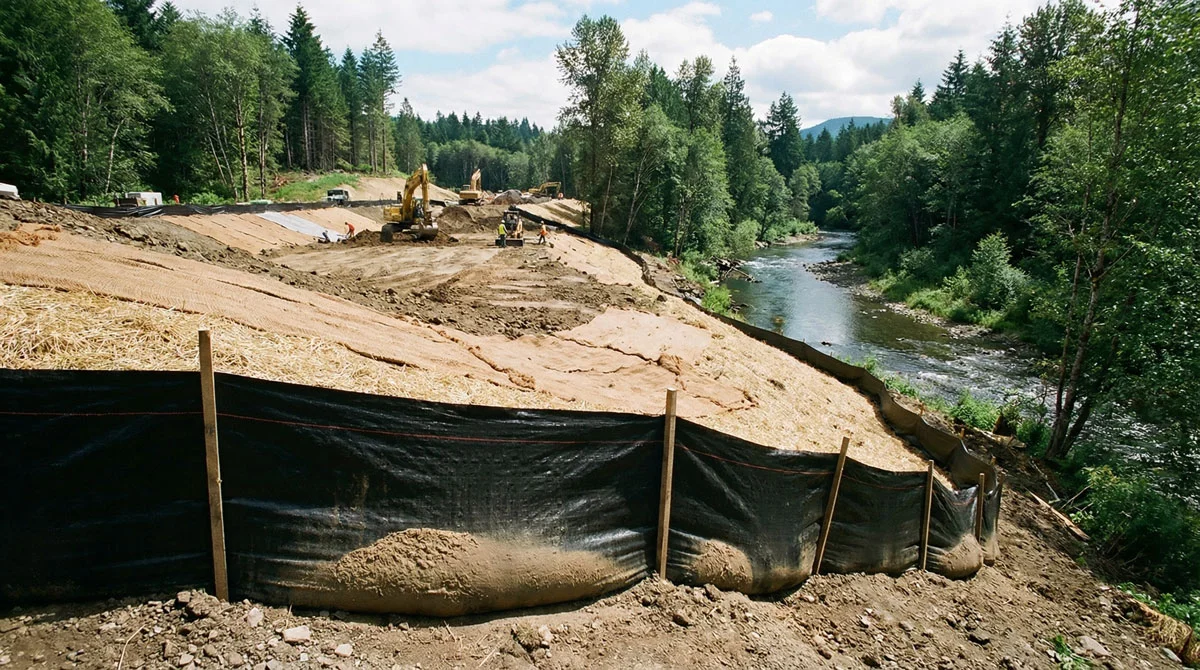
Picture this: a construction site after a heavy downpour. Water rushes off freshly dug earth, turns brown with silt, and flows directly toward the nearest drain. Within hours, that silty water reaches a local waterway — carrying topsoil, fine particles, and pollutants with it. This is precisely the problem that an earth control measure is designed to prevent.
An earth control measure refers to a planned system of practices, structures, and techniques used to control soil erosion, manage sediment movement, and protect surrounding water bodies during construction, earthworks, and land development. It is not just a regulatory formality. It is a practical safeguard for the land, the environment, and the communities that depend on clean water and stable ground.
Whether you are a site engineer, contractor, project manager, or just someone trying to understand why construction sites look the way they do, this guide covers everything you need to know. We will walk through the types of earth control measures available, explain how the ECM tank works, look at what Singapore’s regulatory framework requires, explore seepage control in earth dams, and explain the Certificate of Competency (CoC) that professionals in this field need to hold.
Let’s start with the basics — and why getting this right matters more than most people realize.
Why Earth Control Measures Matter More Than You Think
Soil erosion is one of the oldest environmental challenges in the world. Water and wind wear down exposed earth naturally over time. But when human activity — construction, excavation, land clearing — strips away vegetation and disturbs the ground, erosion accelerates dramatically. What might take nature decades happens in a single rainy season.
The consequences are not just cosmetic. Eroded soil carries fine particles into drainage systems, rivers, lakes, and reservoirs. This sediment reduces water quality, suffocates aquatic life, blocks stormwater infrastructure, and increases the risk of flooding. Loss of topsoil also strips the land of its fertility, making agricultural recovery slow and expensive.
Beyond the environmental damage, there is a legal and financial dimension. Construction projects that fail to implement proper erosion and sediment controls risk stop-work orders, fines, permit revocations, and costly remediation work. In Singapore, for example, construction sites must ensure that any water discharged into public drains meets a total suspended solids (TSS) limit of 50 mg/l — a standard that is difficult to meet without a robust earth control measure system in place.
The good news is that effective controls exist for every project size and type. Understanding which tools to use — and how to use them correctly — is what separates sites that run smoothly from those that create environmental and regulatory headaches.
The Construction Phase Is the Highest Risk Period
During active construction, soil is intentionally exposed for grading, foundation work, drainage installation, and site leveling. This exposure leaves it vulnerable to both surface runoff and wind. The risk is at its peak during the rainy season or whenever heavy downpours occur without warning.
This is why ECM planning must begin before the first piece of earth is moved — not after problems appear. A proactive approach to soil and sediment management protects the site, the surrounding environment, and the project timeline.
Types of Earth Control Measures: Temporary and Permanent
There are two broad categories of earth control measures used in practice: temporary and permanent. Both serve different purposes, and most construction projects rely on a combination of the two.
Temporary Measures: Protecting the Site While Work Is Underway
Temporary measures are put in place during active construction to minimize erosion and contain sediment until the site is stabilized. They are designed to be installed quickly, maintained regularly, and removed or replaced as the project progresses.
Some of the most commonly used temporary controls include:
- Silt Fences: These are porous fabric barriers supported by wooden posts, installed along slopes and site perimeters to intercept sheet flow runoff and capture sediment before it leaves the site. They are among the most widely used controls on small to medium construction sites, though proper installation is critical — studies show that a large proportion of silt fences fail due to poor setup.
- Interceptor Dikes: Built from compacted earth, rock, or sandbags, interceptor dikes are placed across slopes to redirect stormwater runoff and slow its velocity. On long slopes, a series of dikes spaced at calculated intervals prevents large volumes of sediment-laden water from building up momentum.
- Sediment Traps: A sediment trap is a small excavated ponding area with a gravel outlet that allows runoff to settle before being discharged. It is effective on sites with a drainage area of under three acres and a build-out time of six months or less. Importantly, sediment traps only capture medium silt and larger particles — fine silt and clay can still pass through, which is why source control remains the first priority.
- Erosion Control Blankets: Made from natural or synthetic fibers, these blankets are laid over exposed soil to protect it from rainfall impact, slow runoff, and encourage vegetation to establish. They are especially useful on steep slopes and embankments where seeding alone is insufficient.
- Check Dams: Small temporary barriers placed across drainage swales or channels to reduce flow velocity, allow sediment to settle, and prevent channel erosion. Stone check dams are commonly used because they allow water to pass through while trapping heavier particles.
- Stabilized Construction Entrances: Pads of crushed stone installed at site entrances and exits to scrub mud and soil from vehicle tires, preventing sediment from being tracked onto public roads.
Permanent Measures: Long-Term Stability After Construction
Once construction is complete, permanent earth control measures take over to ensure the land remains stable for the long term. These are designed into the site as lasting features, not temporary fixes.
Permanent measures include:
- Revegetation and Grass Filter Strips: Replanting disturbed areas with grass, shrubs, or trees restores the soil’s natural binding system. Grass filter strips along site margins slow runoff, trap sediment, and promote infiltration into the soil rather than surface discharge.
- Retaining Walls and Rip-Rap: On steep slopes or embankments, engineered retaining walls prevent soil mass movement, while rip-rap (large stones placed on the surface) dissipates the energy of flowing water before it can erode the slope face.
- Permanent Drainage Channels: Lined or graded channels direct stormwater off the site in a controlled way, preventing concentrated flows from cutting into unprotected earth.
- Regular Inspection and Monitoring: Even permanent measures require ongoing checks. Vegetation needs time to establish fully, drainage channels can shift with settlement, and retaining structures need inspection after major storm events.
The Earth Control Measure Tank: How It Works and Why It Is Essential
One of the most important components of a modern sediment management system on a construction site is the earth control measure tank — also known as a sediment tank, desilting tank, or portable sediment basin. It is a purpose-built structure that captures and holds silty runoff before it can discharge into public drains or waterways.
The Science Behind Sediment Settlement
The principle is straightforward. Runoff from the construction site flows into the tank, where it slows down significantly. As the water velocity drops, sediment particles lose the energy they need to stay suspended and begin to settle to the bottom under gravity. The cleaner water near the surface then exits through a controlled outlet.
The effectiveness of a sediment tank depends heavily on its size relative to the drainage area it serves, the type of sediment present, and how regularly it is cleaned out. Finer particles like clay take much longer to settle than coarser sand and silt, which is why tank sizing is an engineering calculation, not a guesswork exercise.
In Singapore, the benchmark is clear: all water discharged from a construction site into public drains must contain no more than 50 mg/l of total suspended solids. Reaching this level of water quality without a properly designed and maintained sediment control system is effectively impossible on an active earthworks site.
Sediment Tank vs. Sediment Trap: Choosing the Right Tool
These two terms are often used interchangeably but they refer to different things. A sediment trap is typically an excavated earth basin — a temporary depression dug into the site that collects runoff. A sediment tank, on the other hand, is usually a prefabricated or constructed above-ground structure, often used in urban environments where digging a basin is not feasible.
Sediment traps work well on sites under three acres with short build times. For larger, longer, or more constrained sites — especially in urban Singapore — a portable or constructed sediment tank offers greater capacity, better control over the outlet water quality, and easier maintenance.
Maintenance Is Not Optional
A sediment tank that is not regularly cleaned out stops working. Once the storage volume fills with accumulated sediment, incoming runoff has no room to slow down and settle, and the tank simply becomes a pass-through for polluted water. Most regulatory frameworks require inspections after every significant rain event, not just on a calendar schedule.
Maintenance also means checking that inlet and outlet structures are not blocked, that the tank walls are intact, and that no sediment bypass is occurring around the perimeter. These checks should be documented — not just performed — because regulators and auditors may request records as proof of compliance.
Earth Control Measures in Singapore: What the Regulations Actually Require
Singapore has developed one of the most structured and closely enforced frameworks for construction site sediment management in the world. Given that roughly two-thirds of the island’s land area serves as water catchment, silty runoff from construction sites is not just an aesthetic concern — it is a threat to the national water supply.
The Public Utilities Board (PUB), Singapore’s national water agency, oversees compliance with earth control measure requirements for all construction and earthworks sites. The legal basis comes from the Sewerage and Drainage Act and the Code of Practice on Surface Water Drainage, which set out both the standards that sites must meet and the processes they must follow.
The Role of the Qualified Erosion Control Professional (QECP)
Before any construction or earthworks begin in Singapore, the site owner or occupier must engage a Qualified Erosion Control Professional Engineer — known as a QECP. This is a licensed professional engineer who holds the relevant competency to plan, design, supervise, and review the full earth control measure system for the site.
The QECP is responsible for developing the ECM proposal, which must be submitted to PUB and endorsed before construction starts. This proposal outlines every control measure that will be used on site — what type of silt barriers, where the sediment tanks are located, how water will flow through the system, and how compliance with the TSS limit will be achieved.
However, the QECP is not expected to be on-site at all times. This is where the contractor’s representative comes in — and where the Certificate of Competency becomes critically important.
PUB’s Co-Ownership Approach to ECM
Rather than relying solely on top-down enforcement, PUB has adopted a co-ownership model where contractors, engineers, site personnel, and agency partners all share responsibility for ECM outcomes. This means investing in education, developing accessible tools for compliance, and encouraging industry self-regulation.
PUB also works alongside industry partners to introduce technology upgrades — including automated turbidity monitoring systems at site discharge points, CCTV for silt control, and digital reporting tools that improve transparency and accountability. This approach reflects a broader recognition that good earth control practice is not just about avoiding penalties. It is about building a construction industry that takes environmental responsibility seriously.
Seepage Control Measures in Earth Dams: A Specialized but Critical Application
Earth dams present a unique and highly specialized set of challenges when it comes to managing the movement of water through soil. Unlike a construction site where the concern is surface runoff, an earth dam must contend with water pressing against it from the reservoir side, constantly seeking paths through the embankment and its foundation. Managing this movement — called seepage — is one of the most important aspects of earth dam engineering.
Why Seepage Is Such a Serious Risk
Seepage is not inherently dangerous on its own. Every earth dam allows some water to pass through it. The danger arises when seepage is uncontrolled. If fine soil particles begin to migrate with the seeping water, a process called piping can develop — essentially an underground erosion channel that grows progressively larger until it causes catastrophic failure. History is full of examples of dam failures caused by inadequate seepage management, resulting in devastating floods, property destruction, and loss of life.
Research on earth dam failures consistently shows that the majority of seepage-related incidents come down to inadequate seepage control measures at the design stage. This means the engineering decisions made before construction begins determine whether a dam will perform safely over its entire service life — which may span decades or even centuries.
Key Seepage Control Methods Used in Earth Dams
Engineers use several complementary approaches to manage seepage through earth dam structures. The choice of method depends on the dam’s size, the foundation geology, the type of materials available, and the hydraulic pressures involved.
- Impermeable Core: The most fundamental seepage control is the construction of a low-permeability core within the dam body, usually made from compacted clay or concrete. The core acts as a barrier, forcing water to take a much longer path through the dam and dramatically reducing the volume that passes through. The core must extend down into the foundation to be effective — a core that stops at the base of the embankment while sitting on permeable rock or gravel achieves little.
- Internal Drain Systems: Toe drains, horizontal drainage blankets, and chimney drains are installed within the dam body to intercept and collect seepage that does pass through. Rather than allowing seeping water to exit unpredictably at the downstream face, these systems guide it to a controlled discharge point where it can be measured and monitored. Research shows that combining a rock toe with a horizontal filter produces better results than either measure used alone.
- Upstream Blanket: A layer of low-permeability material placed on the upstream slope of the dam or on the reservoir floor extends the seepage path and reduces the hydraulic gradient that drives water through the foundation.
- Cutoff Walls and Grouting: For dams sitting on permeable foundations, cutoff walls — constructed by injecting grout or installing impermeable barriers — reduce flow through the foundation. Grouting is most effective in fractured rock, bedrock, and abutment zones.
- Filters and Drainage: Properly graded filter layers prevent fine soil particles from being washed out by seeping water. A well-designed filter allows water to pass freely while trapping soil particles, effectively stopping piping from developing.
- Riprap and Erosion Protection: On the downstream face where seepage exits, riprap (large stones or concrete revetments) dissipates the energy of the emerging water and prevents surface erosion.
Monitoring and Ongoing Vigilance
Even the best-designed seepage control system requires continuous monitoring. Important earth dams should be equipped with piezometers to measure water pressure within the embankment, observation wells to detect rising water tables, and seepage collection weirs to track discharge volumes over time.
Any increase in seepage volume, any change in the clarity of seeping water (which might indicate soil particles are being carried out), or any new wet areas on the downstream face should trigger immediate investigation. Regular photographic documentation and written logs provide invaluable baselines for comparison over the dam’s life.
Certificate of Competency (CoC) in Earth Control Measures: Who Needs It and What It Covers
In Singapore, having the right knowledge on-site is not just good practice — it is a regulatory requirement. The Certificate of Competency in Earth Control Measures, administered through the Institution of Engineers Singapore (IES), is a formal qualification designed to ensure that the contractor’s site personnel can correctly implement, operate, and maintain the ECM system designed by the QECP.
Why This Certification Exists
The QECP designs the earth control measure plan. But the QECP cannot be present on site every hour of every working day. The contractor’s representative — a site supervisor, foreman, or designated ECM officer — is responsible for the day-to-day implementation of that plan. If that person does not understand how the system works, why each element is placed where it is, or how to respond when something goes wrong, the entire plan can break down after the first heavy rain.
The CoC course addresses this gap directly. It is a one-day intensive program that trains participants to understand the principles behind earth control systems, recognize when controls are failing, respond to changing site conditions, and document their activities correctly.
What the Course Covers
The CoC curriculum is structured around the practical realities of a construction site. Key topics include:
- Introduction to ECM regulatory requirements and the legal framework under which construction sites must operate
- The science of erosion and sedimentation — what causes it, how it progresses, and how different control measures interrupt the process
- ECM technologies — the full range of tools available, from silt fences to sediment tanks to vegetated buffers, and how each one works
- Reading and understanding an ECM plan — so that site personnel can accurately interpret what the QECP has designed and implement it correctly
- Maintenance procedures — how to inspect, repair, and replace controls, and how often
- Documentation and reporting — what records must be kept and how to complete them
Who Should Get Certified
The CoC is intended for anyone on a construction or earthworks site who is involved in implementing or maintaining sediment controls. This typically includes site supervisors, foremen, safety officers, and project managers. Contractors who employ certified ECM personnel demonstrate due diligence to regulators and reduce their exposure to enforcement action. In competitive tendering, having certified staff on site is increasingly viewed as a professional baseline, not a differentiator.
Building an Effective ECM Plan: From Site Assessment to Implementation
An earth control measure plan is the document that brings everything together. It maps out every erosion and sediment control that will be used on a specific site, where each element will be located, how the system will function as a whole, and how it will be maintained throughout the construction period.
Start with a Site-Specific Assessment
No two sites are identical. The slope of the land, the type of soil, the drainage patterns, the proximity to waterways, and the expected rainfall intensity all affect which controls are appropriate and where they need to be placed. A thorough site assessment should identify all erosion-prone areas, map natural drainage paths, flag sensitive receptors (such as storm drains, streams, or protected vegetation zones), and estimate the volumes of runoff the system will need to handle.
Skipping this step and using a generic ECM plan copied from another project is one of the most common causes of ECM failure. What works well on a flat, sandy urban site may be completely ineffective on a steep, clay-heavy hillside.
Key Elements That Every ECM Plan Should Include
- Clear delineation of the construction zone and its boundaries, showing where land disturbance will and will not occur
- Identification and marking of all sensitive areas — waterways, drainage infrastructure, vegetated buffer zones — that must be protected
- Specification of all temporary controls to be installed before earthworks begin, including silt fences, sediment traps or tanks, check dams, and stabilized site entrances
- Details of permanent measures that will remain in place after construction is complete
- An inspection and maintenance schedule that specifies frequency, responsible parties, and response procedures for damage or failure
- A contingency plan for extreme weather events — because the heaviest rainfall is when ECM systems face their greatest test
Common Mistakes That Undermine ECM Plans
Even well-designed plans can fail in practice. The most frequent problems seen on sites include installing controls after earthworks have already started rather than before, failing to maintain silt fences and sediment traps after each rain event, underestimating the drainage area that a single control must handle, and inadequate documentation that leaves contractors unable to demonstrate compliance when inspectors arrive.
The solution to all of these is simple in principle, though it requires genuine organizational commitment: treat your ECM plan as a live document that is actively managed, not a paperwork exercise that is filed away once the project starts.
Conclusion: Earth Control Is Environmental Responsibility in Action
An earth control measure is, at its core, a promise — a commitment that a project will not damage the waterways, land, and communities around it in the pursuit of development. That promise is made through careful planning, proper tool selection, diligent maintenance, and qualified people on the ground who understand what they are doing and why it matters.
From the basic silt fence to the engineered sediment tank, from the intricate seepage control system in an earth dam to the regulatory framework that Singapore has built around ECM compliance, every element of this discipline exists to solve a real problem: keeping soil where it belongs and keeping water clean.
If you are involved in any type of construction or earthworks project, the message is straightforward. Plan your earth control measures early. Choose the right controls for your specific site conditions. Train your team and ensure the right people hold the right certifications. Maintain every system rigorously, especially after heavy rain. And document everything, because good practice without good records is practice that cannot be proven.
The environment you protect today is the one your project leaves behind for everyone else.
Frequently Asked Questions About Earth Control Measures
1. What is an earth control measure?
An earth control measure is a set of practices, structures, and engineering techniques used to prevent soil erosion, control sediment movement, and protect nearby waterways during construction, excavation, and land development. It includes both physical barriers like silt fences and sediment tanks and biological methods like revegetation.
2. Why is an earth control measure required on construction sites?
Construction exposes large areas of bare soil to rain and wind, dramatically increasing erosion risk. Without proper controls, sediment enters drainage systems and waterways, causing pollution, flooding, and legal liability. Most jurisdictions require ECM compliance as a condition of obtaining construction permits.
3. What is an earth control measure tank?
An earth control measure tank, also called a sediment tank or desilting tank, is a structure installed on construction sites to collect silty runoff and allow sediment particles to settle before the water is discharged into public drains. It helps sites meet the total suspended solids (TSS) discharge standards required by regulators.
4. What are the main types of earth control measures?
Earth control measures fall into two categories: temporary and permanent. Temporary measures include silt fences, sediment traps, interceptor dikes, and check dams. Permanent measures include revegetation, retaining walls, rip-rap, and graded drainage channels designed to remain in place after construction is complete.
5. What does the Certificate of Competency (CoC) in earth control measures cover?
The CoC is a one-day course administered by the Institution of Engineers Singapore (IES) that trains construction site personnel to implement, operate, and maintain ECM systems designed by a Qualified Erosion Control Professional Engineer (QECP). It covers ECM regulations, sediment control technologies, plan interpretation, and maintenance practices.
6. How does Singapore regulate earth control measures on construction sites?
PUB, Singapore’s national water agency, requires construction sites to engage a QECP to design and supervise an ECM system before earthworks begin. Sites must meet a TSS discharge limit of 50 mg/l, submit an endorsed ECM proposal to PUB, and have certified ECM personnel on site to ensure daily compliance.
7. What are seepage control measures in earth dams?
Seepage control measures in earth dams are engineering solutions that manage the movement of water through the dam body and its foundation. They include impermeable cores, internal drain systems such as toe drains and chimney drains, upstream blankets, cutoff walls, filter layers, and erosion protection on the downstream face.
8. How often should earth control measures be inspected and maintained?
Controls should be inspected after every significant rainfall event, not just on a fixed calendar schedule. Silt fences need to be checked for tearing or sediment overflow, sediment tanks require regular desludging, and vegetation-based measures need monitoring until full establishment. All inspections should be documented in writing.
9. What happens if a construction site does not implement proper earth control measures?
Non-compliance can result in stop-work orders from regulatory authorities, substantial financial penalties, and mandatory remediation of damaged waterways. In Singapore, failing to meet PUB’s ECM requirements can also affect a contractor’s standing for future projects and result in increased regulatory scrutiny across all active sites.
10. What is the difference between a sediment trap and a sediment tank? A sediment trap is an excavated earth basin dug into the site to collect and settle runoff, typically used on sites under three acres with short construction timelines. A sediment tank is usually a prefabricated or constructed above-ground structure, better suited to urban sites or larger projects where excavating a basin is not practical. Both serve the same basic function but are chosen based on site conditions and scale.