
Most people follow the NBA for the players — the stars who make impossible shots, the rivalries that keep fans glued to the screen, and the dynasties that define eras. But behind every franchise, there is a person — or a group of people — who actually owns the whole operation. They sign off on trades, write the checks for arena renovations, and set the culture of the entire organization.
The question of who are the NBA owners is more interesting than most fans realize. These are not just rich people who bought a toy. They are some of the most powerful business figures in the world, running companies that stretch across technology, real estate, finance, hospitality, and entertainment.
In 2026, the NBA is a $160 billion enterprise collectively, and the 30 franchise owners are the people who built it to that point. Their personal wealth, their business philosophies, and their willingness to invest in winning all play a massive role in shaping what happens on the court every night.
This article walks you through everything you need to know — from how ownership actually works, to a full team-by-team breakdown, to the wealthiest names at the top of the list, and how NBA owners compare to their counterparts in the NFL and MLB.
Understanding the NBA’s Ownership Structure Before You Look at the Names
Before diving into the individual owners, it helps to understand how the NBA structures ownership at a league level. The NBA does not operate on a simple model where one person buys a team and runs it however they like.
Every principal owner is formally recognized by the NBA as a “Governor.” They are part of the NBA Board of Governors, which is the league’s governing body. This board votes on major decisions, from rule changes to expansion to discipline. So when you own an NBA team, you are not just a private operator — you are one of thirty voices helping steer the entire league.
Ownership structures vary widely across franchises. Some teams have a single controlling majority owner who holds the lion’s share. Others are structured as syndicates or limited partnerships, where multiple investors hold different percentages. Many franchises operate through holding companies and branded sports entities rather than under personal names.
Any transfer of a majority stake requires formal approval from the Board of Governors. That process involves financial disclosures, background checks, and a vote. This keeps a level of accountability built into the ownership system that does not exist in all professional leagues.
One major trend reshaping ownership right now is the entrance of private equity groups and institutional investors. The NBA has opened the door to allow approved investment funds to acquire minority stakes in multiple franchises. This is a significant shift from the traditional single-owner model and reflects just how attractive NBA franchises have become as long-term financial assets.
Average franchise value now sits at $5.4 billion. A decade ago, that number would have seemed wildly optimistic. Today it is simply the floor.
Who Are the NBA Owners? A Complete Team-by-Team Breakdown
Here is a full look at every franchise and the ownership group currently running it. The league is divided into two conferences — Eastern and Western — and the ownership landscape reflects a fascinating mix of tech billionaires, real estate magnates, finance veterans, and a few names from the sports world itself.
Eastern Conference
Atlanta Hawks — Tony Ressler leads the Hawks ownership group. Ressler is the co-founder of Ares Management, one of the largest alternative asset management firms in the world. Alongside him, the group includes Grant Hill, the former NBA star turned executive, and Sara Blakely, the founder of Spanx. The Hawks were acquired in 2015 for $850 million and are currently valued at $3.8 billion.
Boston Celtics — One of the biggest ownership transitions in recent memory happened here. In 2025, William Chisholm, managing partner of STG Partners, led a group that purchased the Celtics from Wyc Grousbeck for $6.1 billion. Grousbeck retains a minority stake. The Celtics are now valued at $6.7 billion, making them one of the most valuable franchises in the league.
Brooklyn Nets — Joe Tsai, co-founder of the Chinese e-commerce giant Alibaba, owns the Nets. Tsai and his wife Clara Wu Tsai hold an 85% majority stake through BSE Global. The franchise is currently valued at $5.6 billion.
Charlotte Hornets — The Hornets went through a landmark sale in 2023 when Gabe Plotkin and Rick Schnall purchased the team from Michael Jordan for $3 billion. Schnall and Plotkin rotate as the active governor on a five-year schedule. Jordan remains a minority owner.
Chicago Bulls — Jerry Reinsdorf has owned the Bulls since 1985, making him one of the longest-tenured owners in professional sports. He paid $16 million for the franchise during the Michael Jordan era and the team is now valued at $6 billion. Reinsdorf also owns the MLB’s Chicago White Sox.
Cleveland Cavaliers — Dan Gilbert, the founder of Quicken Loans (now Rocket Mortgage), has owned the Cavaliers since 2005. He is one of the most vocal and active owners in the league, and his tenure saw the franchise win its first championship in 2016. The team is currently valued at $4.8 billion.
Detroit Pistons — Tom Gores, founder and CEO of Platinum Equity, purchased the Pistons in 2011 for $325 million. That investment has grown significantly — the franchise is now valued at $3.65 billion. Gores manages over $48 billion in assets through Platinum Equity.
Indiana Pacers — Herb Simon bought the Pacers for just $11 million back in 1983, making him the owner with the longest continuous tenure alongside Reinsdorf. Simon co-founded Simon Property Group, one of the world’s largest real estate investment trusts. He holds an 80% stake, with Steven Rales owning the remaining 20%.
Miami Heat — Micky Arison, chairman of Carnival Corporation, the world’s largest cruise operator, has owned the Heat since 1995 when he received majority ownership from his father. His net worth is estimated at $8.6 billion, and the Heat have won three championships under his ownership.
Milwaukee Bucks — Marc Lasry and Wes Edens originally purchased the Bucks in 2014. Since then, ownership has evolved with new investors joining. The franchise won the 2021 championship under this ownership group’s tenure.
New York Knicks — The Dolan family has owned the Knicks since 1997. The Dolans built their wealth through Cablevision, which was sold to Altice USA for $17.7 billion in 2016. James Dolan remains the executive chairman of Madison Square Garden Sports Corp. The Knicks are one of the most valuable franchises despite years of on-court struggles.
New Orleans Pelicans — Gayle Benson is the owner of both the Pelicans and the NFL’s New Orleans Saints. Her late husband Tom bought the then-Hornets from the NBA in 2012 for $338 million, and Gayle took over following his passing in 2018.
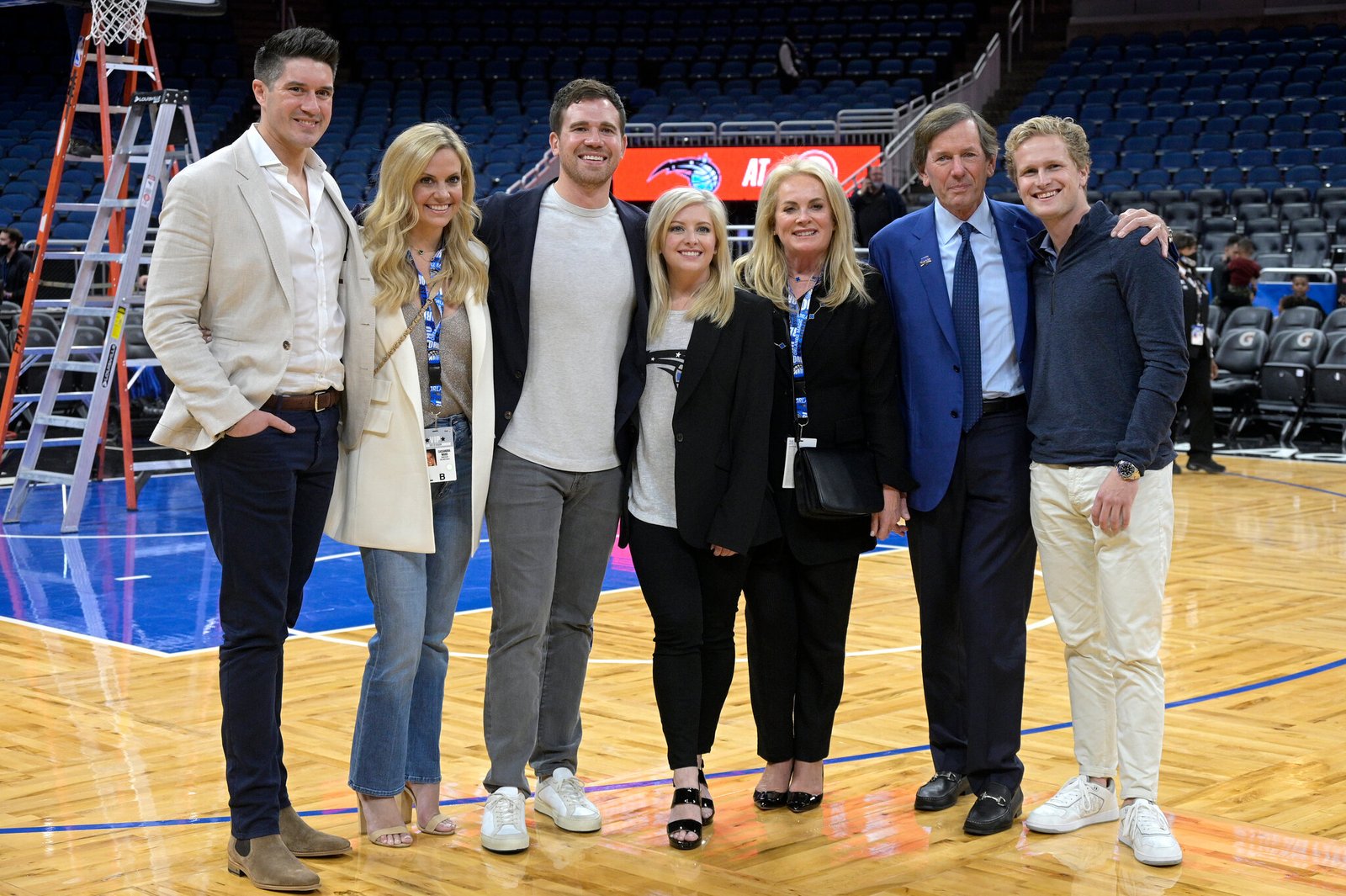
Orlando Magic — The DeVos family has owned the Magic since 1991, when the late Richard DeVos, co-founder of Amway, purchased the franchise for $85 million. His son Dan DeVos has served as chairman since 2011.
Philadelphia 76ers — Josh Harris, co-founder of Apollo Global Management, leads the 76ers ownership group. Harris is a significant name across multiple sports leagues and will be covered further in the cross-league comparison section.
Toronto Raptors — Larry Tanenbaum chairs Maple Leaf Sports and Entertainment, which owns the Raptors alongside the NHL’s Toronto Maple Leafs and MLS’s Toronto FC.
Washington Wizards — Ted Leonsis, founder of Monumental Sports and Entertainment, has owned the Wizards since 2010. He also owns the NHL’s Washington Capitals and has been instrumental in pushing for a new downtown arena in D.C.
Western Conference
Dallas Mavericks — Miriam Adelson, Sivan Ochshorn, and Patrick Dumont hold a combined 69% majority stake, with Mark Cuban retaining 27%. The Adelson family fortune comes from Las Vegas Sands, the casino empire built by the late Sheldon Adelson.
Denver Nuggets — Ann Walton Kroenke controls the Nuggets through Kroenke Sports and Entertainment. The KSE empire also includes the NFL’s Los Angeles Rams, the NHL’s Colorado Avalanche, MLS’s Colorado Rapids, and English Premier League club Arsenal FC.
Golden State Warriors — Joe Lacob, alongside Peter Guber and investment group Arctos Partners, owns the Warriors. Lacob purchased the team in 2010 for $450 million. The franchise is now the most valuable in the NBA at $11 billion, the highest valuation in the league for four consecutive years.
Houston Rockets — Tilman Fertitta, founder of Landry’s Inc. and owner of the Golden Nugget casino chain, bought the Rockets in 2017. He runs one of the largest restaurant and hospitality groups in the country.
Los Angeles Clippers — Steve Ballmer holds a 99% stake in the Clippers. He is the richest NBA owner in the world and the richest sports team owner globally, with an estimated net worth of $139 billion as of 2025. More on Ballmer in the section ahead.
Los Angeles Lakers — In 2025, Mark Walter completed the purchase of the Lakers for approximately $10 billion — the highest amount ever paid for a U.S. professional sports franchise. Walter is also the controlling owner of the MLB’s Los Angeles Dodgers. Jeanie Buss, from the founding Buss family, remains as governor.
Memphis Grizzlies — Robert Pera, founder and CEO of Ubiquiti, a global technology company, has owned the Grizzlies since 2012. His estimated net worth is $19.9 billion.
Minnesota Timberwolves — Marc Lore, the e-commerce entrepreneur and former Walmart executive, and Alex Rodriguez, the former MLB star, completed the purchase of the Timberwolves from Glen Taylor for $1.5 billion in 2025.
Oklahoma City Thunder — Clay Bennett has owned the Thunder since the franchise relocated from Seattle in 2008. He is among the less publicly visible owners in the league.
Phoenix Suns — Mat Ishbia, president and CEO of United Wholesale Mortgage, purchased the Suns in 2023 for $4 billion from the controversial Robert Sarver.
Portland Trail Blazers — Tom Dundon acquired the Trail Blazers for just over $4 billion from the estate of Paul Allen in 2025. Dundon is also the owner of the NHL’s Carolina Hurricanes.
Sacramento Kings — Vivek Ranadivé, the founder of TIBCO Software and Teknekron, has owned the Kings since 2013. He made history as the first person of Indian descent to have a controlling ownership stake in an NBA franchise.
San Antonio Spurs — Peter J. Holt is the chairman and CEO of Spurs Sports and Entertainment, inheriting the role from his father Peter M. Holt. The Spurs have one of the most celebrated ownership legacies in the league, marked by sustained winning over several decades.
Utah Jazz — Ryan Smith, co-founder of the software company Qualtrics, purchased the Jazz in December 2020 for $1.66 billion from Gail Miller. Smith is one of the younger and more tech-forward owners in the league.
Who Are the Richest NBA Owners? The Top Names by Net Worth
When people ask who are the NBA owners at the very top of the wealth ladder, the answer is both impressive and a little staggering. The gap between the richest NBA owner and the rest of the field is not a gap — it is a canyon.
Steve Ballmer — The Undisputed Richest NBA Owner
Steve Ballmer, the former CEO of Microsoft and current owner of the Los Angeles Clippers, carries an estimated personal net worth of $139 billion as of mid-2025. That number makes him not just the wealthiest owner in the NBA but the richest sports team owner anywhere on the planet.
Ballmer joined Microsoft as employee number 30 in 1980. He climbed to CEO in 2000 and grew annual revenue from $25 billion to $70 billion before stepping down in 2014. He retained a significant stake in Microsoft, and its continued appreciation is the engine behind his extraordinary fortune.
He purchased the Clippers in August 2014 for $2 billion — a record at the time for a professional basketball team, and a purchase that came under dramatic circumstances following the forced ouster of the previous owner. Under his watch, the franchise has transformed. The team moved into the Intuit Dome, a $2 billion arena that opened in August 2024, which Ballmer personally funded.
The gap between Ballmer and the second-richest NBA owner is roughly $90 billion. That is not a typo.
Robert Pera, Stan Kroenke, and the Rest of the Top Tier
Robert Pera, owner of the Memphis Grizzlies, sits at approximately $19.9 billion. He built his wealth through Ubiquiti, a global networking technology company he founded that has become a major force in broadband infrastructure worldwide.
Stan Kroenke, who controls the Denver Nuggets through Kroenke Sports and Entertainment, is estimated at around $18 billion. His wealth spans real estate, sports franchises, media, and even fine wine — he owns the prestigious Screaming Eagle Winery in Napa Valley. His KSE empire covers multiple major sports teams across four different leagues.
Other high-net-worth owners worth noting include Joe Tsai (Brooklyn Nets) whose Alibaba-derived wealth places him comfortably in the multi-billion range, and Tom Gores (Detroit Pistons) who manages over $48 billion in assets through Platinum Equity.
What Industries Produced the Wealthiest NBA Owners?
Looking across the full ownership list, a few patterns jump out clearly.
Technology: Ballmer (Microsoft), Pera (Ubiquiti), Tsai (Alibaba), Smith (Qualtrics), Ranadivé (TIBCO) — tech is by far the dominant source of NBA ownership wealth.
Real Estate and Finance: Simon (Simon Property Group), Kroenke, Gilbert (Rocket Mortgage) — real estate and lending have produced several franchise owners.
Hospitality and Gaming: Fertitta (Landry’s and Golden Nugget), the Adelson family (Las Vegas Sands) — casino and restaurant empires have found a home in NBA boardrooms.
Private Equity and Asset Management: Ressler (Ares Management), Lacob (Kleiner Perkins), Harris (Apollo Global) — Wall Street money is deeply woven into NBA ownership.
The one thing almost all of them have in common is that their wealth came from somewhere else first. They did not get rich by owning a basketball team. They got rich, and then they bought a basketball team.
NFL, MLB, NBA — Who Are the Richest League Owners When You Compare All Three?
Fans who follow multiple sports often wonder how NBA team owners stack up against the owners running NFL and MLB franchises. The comparison reveals some surprising differences in both wealth concentration and franchise economics.
How NBA Owners Compare to NFL Owners
The NFL remains the dominant revenue machine in American sports. Average NFL franchise value hit approximately $7.65 billion in 2025, representing an 18 percent year-over-year increase. That is higher than the NBA’s average of $5.4 billion.
At the top of the NFL wealth ladder, Rob Walton and family (Denver Broncos) lead with an estimated $77.4 billion in net worth, thanks to the Walton family’s ownership of Walmart. That is significant, but it still falls far short of Steve Ballmer’s $139 billion.
Other notable NFL owner names include Stan Kroenke ($18 billion, Los Angeles Rams) — who is also an NBA owner through the Denver Nuggets, making him one of the most powerful figures across both leagues — and David Tepper ($20.6 billion, Carolina Panthers), who made his fortune running the hedge fund Appaloosa Management.
The key difference: NFL franchises command higher average valuations, but NBA ownership contains the single richest individual across all three major leagues in Ballmer.
How NBA Owners Compare to MLB Owners
MLB ownership wealth tends to be more distributed and slightly lower on average than the NBA or NFL. Steve Cohen of the New York Mets, with an estimated $21.3 billion, is the richest owner in Major League Baseball. He built his fortune founding Point72 Asset Management, one of America’s major hedge funds.
One figure who connects the NBA and MLB is Mark Walter. He paid $10 billion to buy the Los Angeles Lakers in 2025 — the highest amount ever paid for any U.S. professional sports franchise — and he is also the controlling owner of the MLB’s Los Angeles Dodgers. Cross-league ownership at this level is becoming more common and signals just how attractive these assets are to serious investors.
Josh Harris (76ers) is another cross-sport owner, with stakes in the NFL’s Washington Commanders and the NHL’s New Jersey Devils, showing how the wealthiest figures are building diversified sports empires rather than committing to a single league.
The Bottom Line on League Comparisons
NFL: Highest average franchise value, but individual owner wealth is spread more evenly. NBA: Has the single richest owner in the world. MLB: More accessible entry points historically, but values are climbing fast. What all three have in common is consistent long-term value appreciation. Owning any major professional sports franchise in America has become one of the most reliable wealth-building assets available.
Why the World’s Billionaires Keep Buying NBA Teams
When Mark Walter paid $10 billion for the Lakers in 2025, the reaction ranged from shock to inevitability depending on who you asked. But the number makes sense once you understand the business model.
NBA franchise values have compounded at a pace that few traditional investments can match. The collective value of all 30 franchises reached $160 billion in 2025 — up dramatically from just a few years prior. That growth comes from several interconnected revenue streams.
The Revenue Engines Behind NBA Ownership
Broadcast Rights: Television and streaming deals are the single largest revenue source for the NBA. The league’s national TV contract is worth billions annually, and those dollars flow directly to ownership groups.
Sponsorships and Naming Rights: Arena naming deals, jersey patch sponsorships, and corporate partnerships provide significant revenue that did not exist at this scale a generation ago.
Arena Revenue: Owners who control their own arenas capture a much larger share of the economics. Ballmer’s Intuit Dome is a prime example — a $2 billion arena that opened in 2024 and has already hosted over 100 events attracting more than a million fans.
International Expansion: The NBA’s global reach is unmatched among American sports leagues. This creates licensing, merchandise, and broadcast revenue from markets around the world, and it continues to grow.
Real Estate and Development: Some ownership groups are pairing their arena investments with broader real estate development around the venue, turning the franchise into an anchor for multi-billion dollar neighborhood projects.
How Ownership Style Shapes a Franchise
Not all owners operate the same way. Some are deeply involved in basketball decisions — Ballmer is famous for sitting courtside and being visibly invested in every possession. Others take a more removed approach, focusing on the business side while trusting front office executives to run the basketball operation.
The owner’s philosophy filters through the entire organization. An owner willing to spend on player development, coaching, and analytics will generally build a more competitive team over time. An owner focused purely on profit margins may cut corners that eventually show up in the standings.
Fan perception of ownership matters more than ever. In today’s social media environment, owners can become beloved or reviled figures depending on how publicly they engage with the team and its community.
Ownership Changes That Shaped the Modern NBA
The past several years have produced some of the most dramatic and expensive ownership transitions in the history of professional basketball. Understanding these moves gives important context to the current state of the league.
The $10 Billion Lakers Sale
When Mark Walter’s group purchased the Los Angeles Lakers for approximately $10 billion in 2025, it set a new record for any professional sports franchise sale in American history. The Lakers are the most globally recognized basketball brand, with 17 championships and a legacy that spans decades of iconic players. The price tag reflected all of that, and then some.
The Boston Celtics Transition
Bill Chisholm’s $6.1 billion acquisition of the Celtics from Wyc Grousbeck in 2025 was another watershed moment. For a franchise that had been owned by its previous group since 2002, the transition marked the beginning of a new chapter — one that coincided with the team’s recent resurgence as a championship contender.
Michael Jordan’s Exit from Charlotte
When Michael Jordan sold the Hornets to Gabe Plotkin and Rick Schnall for $3 billion in 2023, it closed a notable chapter in NBA ownership history. Jordan had been the only former player to have a majority ownership stake in an NBA franchise, and his exit was both a business decision and the end of an experiment that sports fans had watched closely for over a decade.
The Rise of Athlete and Celebrity Co-Ownership
One of the most interesting recent trends is the growing presence of former athletes and entertainers in NBA ownership groups. Alex Rodriguez became a co-owner of the Timberwolves alongside Marc Lore. Grant Hill joined the Hawks ownership group led by Tony Ressler. These arrangements are not purely ceremonial — the athlete co-owners often serve real roles in community engagement and player relations.
This trend reflects something broader: the NBA is increasingly blurring the line between the playing side of the sport and the business side. Former players understand the culture in ways that pure financial investors may not, and teams are finding value in that perspective at the ownership level.
Private Equity Enters the Room
Perhaps the biggest structural shift is the entrance of institutional investment into NBA ownership. The league has approved frameworks that allow qualified private equity groups to hold minority stakes in NBA franchises. This opens the door to a new class of part-owner who approaches these assets as portfolio investments rather than passion projects. It also suggests the league is preparing for an era where franchise values become even harder for individual buyers to finance alone.
So, Who Are the NBA Owners — And Why Does It Matter to Fans?
Understanding who are the NBA owners gives basketball fans a much deeper lens for watching the sport. Every trade deadline decision, every arena announcement, every jersey sponsorship, and every front office hire traces back to the ownership suite.
The people running these franchises are some of the most accomplished and wealthiest individuals in the world. They come from technology, real estate, finance, hospitality, and media. They have built companies that employ hundreds of thousands of people globally. And now they are pouring that same energy, ambition, and capital into basketball franchises.
The stakes have never been higher. A single NBA franchise is now worth more than most entire corporations. The average team value of $5.4 billion is a number that barely anyone predicted a decade ago, and there is no sign that appreciation is slowing down.
For fans, this landscape matters because ownership shapes everything. A patient owner who invests for the long term builds differently than one chasing quick wins or focused on the bottom line. A hands-on owner who loves the game creates a different culture than a distant investor who sees the franchise primarily as a financial instrument.
The NBA is bigger, richer, and more globally powerful than at any point in its history. And the people who own it — a collection of extraordinary business minds, risk-takers, and sports obsessives — have a lot to do with why.
Frequently Asked Questions About NBA Owners
1. Who is the richest NBA owner in 2026?
Steve Ballmer, owner of the Los Angeles Clippers, is the richest NBA owner in 2026 with an estimated net worth of $139 billion. His wealth comes primarily from his long tenure at Microsoft, where he served as CEO from 2000 to 2014, and from his retained shareholding in the company.
2. Who are the NBA owners with the most championships under their ownership?
Jerry Reinsdorf of the Chicago Bulls won six championships with the team during the Michael Jordan era. Micky Arison of the Miami Heat has overseen three championships. The late Jerry Buss of the Lakers won ten titles during his ownership before the franchise transferred to his family.
3. How many NBA owners are there in total?
There are 30 NBA franchises and therefore 30 primary ownership groups. However, each group can contain multiple minority stakeholders, limited partners, and co-investors, meaning the total number of individuals with an ownership interest across the league runs into the hundreds.
4. Can a former NBA player own a team?
Yes. Michael Jordan was the most prominent example, owning the Charlotte Hornets as a majority stakeholder until 2023. Former players like Grant Hill and Alex Rodriguez currently hold minority ownership stakes in franchises, and the trend of athlete co-ownership is growing steadily.
5. What is the most expensive NBA team sale in history?
The Los Angeles Lakers were sold in 2025 for approximately $10 billion to Mark Walter’s ownership group, making it the most expensive U.S. professional sports franchise sale on record. It surpassed the previous record set by the Washington Commanders NFL sale.
6. Who are the NBA owners that also own teams in other leagues?
Several owners operate across multiple leagues. Stan Kroenke (Nuggets) also owns the NFL’s LA Rams, NHL’s Colorado Avalanche, and Premier League’s Arsenal. Mark Walter (Lakers) owns the MLB’s LA Dodgers. Gayle Benson (Pelicans) also owns the NFL’s New Orleans Saints. Josh Harris (76ers) owns the NFL’s Washington Commanders.
7. How does someone become an NBA owner?
A person or group must purchase a controlling stake from existing ownership, with the transaction requiring formal approval from the NBA Board of Governors. The process involves financial disclosures, vetting, and a vote by current team governors. The NBA has strict standards around financial capacity and character.
8. What is the least valuable NBA franchise and who owns it?
By most estimates, franchises in smaller markets like Memphis, New Orleans, and Oklahoma City tend to carry lower valuations compared to big-market teams. However, even the least valuable NBA franchises are now worth several billion dollars, reflecting the league-wide appreciation of franchise assets.
9. Who are the NBA owners that paid the least for their franchise historically?
Herb Simon purchased the Indiana Pacers for just $11 million in 1983. Jerry Reinsdorf bought the Chicago Bulls for $16 million in 1985. These are perhaps the most staggering examples of franchise appreciation in American sports history, with both teams now valued in the billions.
10. Are NBA owners involved in day-to-day basketball decisions?
It varies widely. Some owners, like Steve Ballmer, are famously hands-on and publicly enthusiastic. Others prefer to hire strong front office leadership and stay in the background. The basketball decisions are typically handled by the team’s general manager and front office, but ownership sets the vision, the budget, and ultimately the culture of the franchise.