
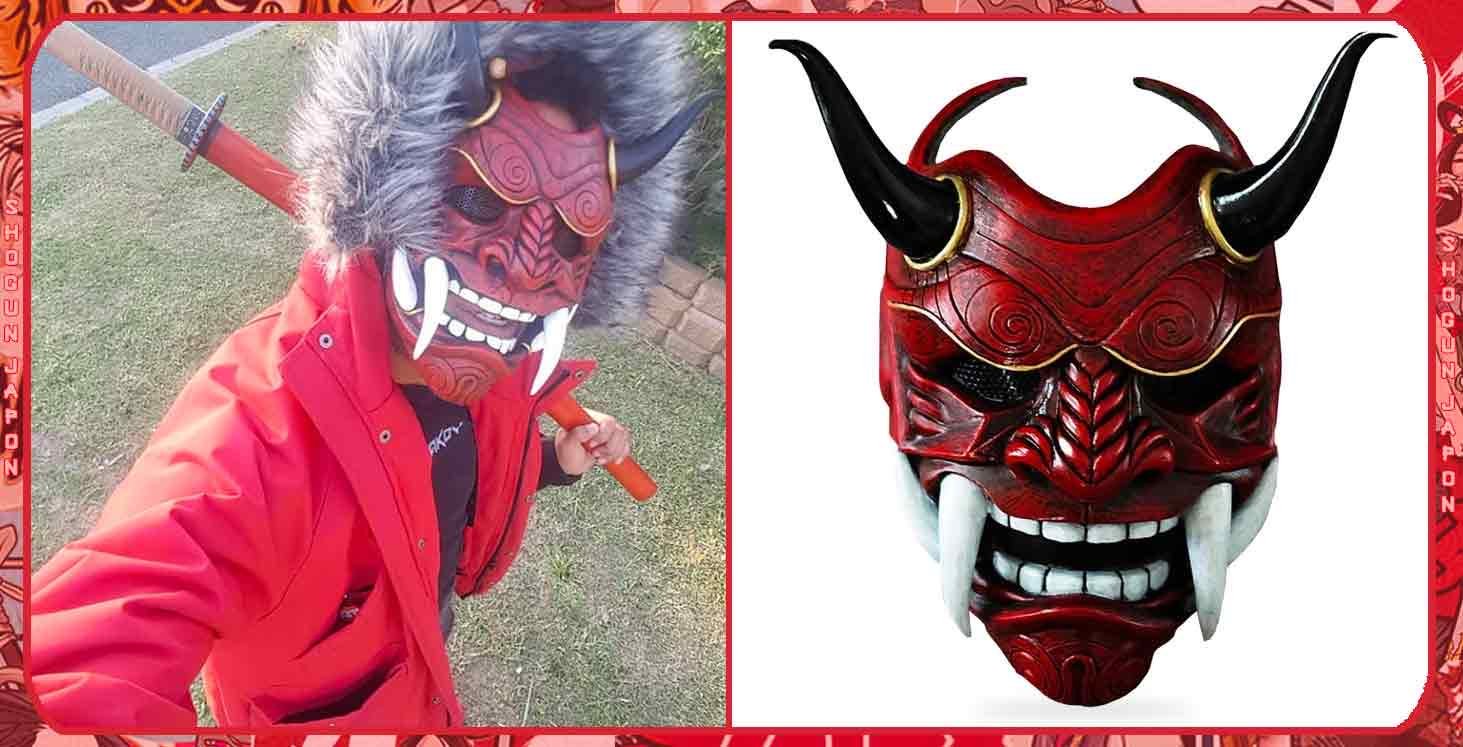
Picture this. It is early February in Kyoto. The air is cold, and a crowd has gathered outside a temple. Then, from the shadows, a figure steps forward wearing a massive scarlet face — wide eyes, curling horns, and a mouth full of jagged teeth frozen in a roar. Children scatter. Adults toss handfuls of roasted soybeans and shout, “Oni wa soto! Fuku wa uchi!” — “Demons out! Fortune in!”
That figure is wearing an oni mask. And the moment you watch it in action, you start to understand that the oni mask meaning goes far deeper than pure horror.
Most people outside Japan see this mask and stop at the obvious — it looks menacing, aggressive, maybe even evil. But that first impression only scratches the surface. The oni mask is one of the most layered symbols in all of Japanese culture. It holds contradiction at its very core. It is the face of a creature that punishes sinners and also guards temple rooftops from harm. It is something people fear and something people wear for protection — sometimes at the very same time.
This article breaks down everything worth knowing about the meaning of oni mask, from its ancient origins in Japanese folklore to the colors that carry specific spiritual weight, its role in festivals and theater, and what it signals when someone chooses it as a permanent tattoo. By the time you finish reading, you will see this fierce, horned face in an entirely different light.
What Is an Oni? Understanding the Creature Behind the Mask
Before the mask makes sense, the creature behind it has to make sense first.
An oni is not a demon in the way Western culture understands the word. It is not Satanic, it is not a fallen angel, and it does not carry the theological baggage that the word “demon” implies to most English speakers. An oni is better understood as a supernatural ogre — a massive, powerful, deeply unsettling being from Japanese folklore that occupies a space somewhere between monster and divine enforcer.
The word itself is telling. Most scholars trace “oni” back to the old Japanese word on, meaning “to hide.” That etymology quietly says everything about what the oni represents — something lurking just out of sight, present but unseen, watching from the edges of the mortal world.
In ancient Japan, mountain giants and antagonistic nature spirits were also labeled oni, using Japanese characters that translated roughly to “great being.” These were not small creatures. They were forces.
Physically, oni are described with remarkable consistency across centuries of Japanese art and storytelling. They stand taller than any human. Their skin burns red, blue, or sometimes green. Horns — one or two, occasionally more — jut from their foreheads. Their mouths are wide and full of fang-like teeth. Their eyes bulge. Their hair is wild. They carry iron clubs called kanabō and wear loincloths made of tiger skin.
Oni belong to the broader category of yōkai — a vast umbrella term in Japanese folklore that covers supernatural creatures, spirits, and strange phenomena. Fellow yōkai include the kitsune (fox spirit), the tengu (winged mountain creature), and the yukionna (snow woman). But among all yōkai, the oni carries the most cultural weight.
How the Oni Shifted from Pure Evil to Something More Complex
In the earliest layers of Japanese mythology, oni were straightforwardly terrifying. They caused disease. They stirred up wars. They were blamed for natural disasters and sent to drag sinners into Buddhist hell for punishment. Society used the oni as a focal point for its worst anxieties — if something terrible happened, an oni was behind it.
But Buddhism, which spread through Japan from around the 6th century onward, complicated this picture in the best possible way. Within Buddhist cosmology, oni became the enforcers of karmic justice. They were the ones who weighed the sins of the dead and carried out punishment in the underworld. This gave them a role that was frightening, yes — but also necessary. An oni was not chaotic evil. It was a servant of moral order.
That shift planted the seed for everything the oni mask meaning would eventually grow into.
The Oni Mask Meaning Through the Centuries
Here is the central truth about the oni mask meaning: it has never been static.
When oni masks first appeared in Japanese religious practice — dating back to at least the Heian period, roughly 794 to 1185 CE — they were objects of genuine fear. Wearing or displaying an oni mask was a way of acknowledging the terrifying power of supernatural forces. The mask was not decorative. It was a spiritual tool.
Over time, something remarkable happened. The very thing that made the oni mask frightening became the reason people wanted it on their side. If an oni was powerful enough to drag souls into hell, then wearing the face of an oni was powerful enough to drive evil away. The mask crossed over from representing danger to offering protection.
This is the core duality that defines the oni mask across every context it appears in. In Japanese culture, oni masks represent something simultaneously feared and venerated. By placing or wearing the mask, a person symbolically borrows the power of the demon and turns it outward — at whatever threat might be approaching.
There is a second layer of meaning here that is equally important. Many cultural observers have pointed out that the oni mask represents the shadow side of human nature. Everyone has impulses they keep in check — anger, jealousy, cruelty, selfishness. The oni face is that shadow made visible. Displaying it honestly, rather than pretending the darkness does not exist, is its own kind of strength.
This interpretation resonates far beyond Japan. It is part of why the oni mask meaning has traveled so well into global tattoo culture, streetwear, and modern art. People everywhere recognize the honesty of a symbol that says: yes, darkness exists — and I am not afraid of it.
Protection, Power, and the Mask as Guardian
In traditional Japanese architecture, you will find oni faces built directly into the rooftiles of temples and old homes. These are called oni-gawara — oni roof tiles — and their purpose is entirely protective. The fierce expression faces outward, toward whatever spiritual threats might approach.
This same logic applies when people wear oni imagery as jewelry, print it on clothing, or hang a carved mask on their wall. The meaning of oni mask in this context is clear: it is a guardian symbol. The face that once represented destruction now stands at the door to keep destruction out.
Breaking Down the Colors and What They Really Mean
Ask most people what color an oni mask is, and they will say red. They are not wrong — red is the most common and most recognized version. But color in oni mask symbolism is not a matter of aesthetics. Each shade carries specific meaning rooted in Buddhist philosophy.
The oni mask’s color system maps to the Buddhist concept of the gogai — the five hindrances of the mind, the obstacles that block a person from reaching spiritual clarity and awakening. Each color represents one of these obstacles.
Red Oni — Red is passion, rage, and burning desire. It is the most visceral of the oni types, the one most associated with raw emotional power. At the Setsubun festival, the red oni is the one being driven out of homes with thrown soybeans. In tattoo art, a red oni mask meaning typically centers on intensity, strength, and unstoppable drive.
Blue Oni — Blue carries a different weight. Where red burns hot, blue runs cold and calculating. Blue oni represent cunning, melancholy, and a slower, more deliberate kind of danger. In the classic folk tale of the red and blue oni, the blue oni is the strategist — the one who devises the plan while his companion acts on impulse.
Black Oni — Black oni are the rarest and arguably the most foreboding. They embody absolute evil, deep mystery, and the truly unknowable. A black oni mask meaning leans into darkness without redemption — the shadow with no silver lining.
Green Oni — Green oni are associated with illness, envy, and spiritual sickness. They appear less frequently in popular imagery but carry real weight within Buddhist spiritual mapping.
Yellow Oni — Yellow represents greed, obsession with material things, and attachment to outcomes. It completes the five-hindrance system alongside the other colors.
Understanding these distinctions matters when someone is choosing an oni mask for display or as a tattoo. The color is not decoration — it is a statement.
The Oni Mask in Japanese Ritual and Theater
The oni mask has never existed purely as an object to look at. It has always been an object to use — in ceremony, in performance, in ritual. Understanding where the mask appears in Japanese tradition gives the oni mask meaning its full texture.
Setsubun — The Festival That Brings the Mask to Life
Setsubun falls on February 3rd and marks the turning point between winter and spring in the traditional Japanese calendar. At its heart, it is a purification ritual — a way of sweeping out the bad energy of the past year and inviting good fortune into the new season.
The oni mask is the centerpiece of the celebration. One family member — often the father, or sometimes a visiting temple performer — puts on an oni mask and plays the role of the evil spirit trying to enter the home. The rest of the family drives this “demon” away by hurling roasted soybeans while chanting the famous phrase: “Demons out! Fortune in!”
What is beautiful about this ritual is how perfectly it captures the oni mask meaning as the culture understands it. The oni is not secretly good. It is being driven out. But the act of confronting it directly, giving it a face and chasing it away with intention, is itself the protection. The mask makes the invisible visible so it can be defeated.
Beyond Setsubun, oni masks appear in the Obon festival, regional matsuri celebrations throughout the year, and various New Year rituals. Each context uses the mask to draw a boundary between the human world and the spirit world — to acknowledge the supernatural and then assert that people have power over it.
Noh Theater and Kabuki — The Mask as Storyteller
Japanese classical theater has a long and sophisticated relationship with masks, and the oni mask sits at the dramatic heart of this tradition.
In Noh theater, masks are called omote — and that word carries a double meaning that reveals everything. Omote means both “mask” and “face.” The Japanese cultural understanding is that a mask does not hide the true face — it reveals another one. Wearing an oni mask in Noh is not pretending to be something you are not. It is temporarily allowing something else to speak through you.
Kabuki approaches the oni with more theatrical flair — brighter colors, more extreme expressions, greater physical drama. Where Noh is restrained and deeply interior, Kabuki is external and spectacular.
It is worth mentioning the Hannya mask here because it is frequently confused with the standard oni mask. The Hannya is technically a female oni — specifically, the face of a woman consumed by jealousy and heartbreak to the point of spiritual transformation into a demon. The Hannya mask is instantly recognizable by its narrower, more sorrowful features compared to the broad aggression of the standard male oni. They share a family resemblance but carry distinctly different stories.
What the Oni Mask Tattoo Meaning Says About the Person Wearing It
Of all the ways the oni mask appears in modern life, perhaps none is more personal than as a permanent tattoo. And the oni mask tattoo meaning is rich enough to support that permanence.
In traditional Japanese tattooing — known as irezumi — the oni mask has been a beloved motif for centuries. In the Edo period, when irezumi began to flourish as a genuine art form, the oni mask was already established as one of the most powerful images a tattoo artist could render. Warriors favored it. Those who lived dangerous lives sought it for protection. Those who had faced great hardship wore it as proof.
Today, the oni mask tattoo meaning draws on all of that history while carrying deeply personal interpretations. Here are the core meanings most commonly associated with this tattoo:
Protection — The fierce expression acts as a ward. Whatever evil, bad luck, or negative energy might approach, the oni face turns it away. This is the oldest and most consistent meaning of the mask, and it transfers directly to the skin.
Strength and Resilience — The oni represents power that does not break. People who have fought through difficult circumstances — illness, loss, personal failure, addiction — often choose this tattoo to mark what they survived.
Duality and Transformation — This is one of the most psychologically rich readings of the oni mask tattoo meaning. It is an acknowledgment that every person carries both light and shadow, and that the shadow, when understood rather than denied, can become a source of strength.
Justice — Oni in Buddhist mythology punish the wicked and reward the righteous. Wearing the oni mask can be a personal commitment to living with integrity — a reminder that consequences follow cruelty.
Respect for Tradition — For many wearers, the tattoo is simply an act of deep respect for Japanese culture, mythology, and the centuries-old art of irezumi.
Style, Placement, and Design in Oni Mask Tattoos
In traditional irezumi, no motif exists in isolation. An oni mask placed on bare skin is just a mask. The same oni surrounded by crashing waves, curling flames, cherry blossoms, or storm clouds becomes a living image — the background gives it movement, context, and power.
Serious irezumi artists will tell you that the composition must work with the body’s natural contours. Waves follow the ribs. Clouds wrap around the shoulder. The oni watches from the center while the world moves around it.
For people who want a more contemporary approach, the oni mask tattoo translates well into neo-traditional style — saturated colors, bold outlines, ornamental framing. Black and gray realism produces stunning results, especially for capturing the texture of the horns, the depth of the eyes, and the sharpness of the teeth. Fine-line and blackwork versions have gained popularity for smaller placements on the forearm, calf, or behind the ear.
Placement matters too. The back gives the most canvas for a full composition. A sleeve allows the design to wrap and flow. The chest placement carries a sense of wearing armor — the demon face guarding the heart.
From Folklore to Fashion — The Oni Mask in Modern Global Culture
The oni mask meaning has not stayed contained within Japan. It has traveled, and it has adapted.
In anime and manga, oni characters and their masks appear constantly — from the Demon Slayer series to Naruto, from Dororo to countless others. Video games like Elden Ring feature oni-inspired designs. Streetwear brands have incorporated oni mask graphics into hoodies, sneakers, and accessories on a global scale.
What is interesting about this global spread is that the symbol does not lose its meaning through the journey. People who encounter the oni mask in a video game often end up researching the actual cultural tradition behind it. The path from pop culture to genuine cultural interest is well-traveled.
That said, thoughtful engagement with the symbol matters. The oni mask is not a Halloween costume. It carries over a thousand years of spiritual, artistic, and cultural meaning. For people outside Japan who feel drawn to the image — whether as a tattoo, a piece of art, or an object displayed at home — understanding what the mask actually means is the first step toward genuine appreciation rather than shallow appropriation.
The deeper truth about why the oni mask resonates globally is this: the themes it carries are universal. Every human culture has grappled with darkness, with the shadow side of personality, with fear and how to face it. The oni mask gives all of that a face. It says that power can be reclaimed from what frightens us. It says that even the demon can stand at the door and keep harm away.
That message lands across cultures, languages, and centuries. It lands today just as powerfully as it did in a Heian-era temple a thousand years ago.
Frequently Asked Questions About Oni Mask Meaning
1. What is the basic oni mask meaning? The oni mask meaning centers on power, protection, and duality. Originally representing evil spirits in Japanese folklore, the mask evolved into a symbol of strength and a guardian against harm. It reflects the idea that facing darkness directly gives you power over it.
2. Is an oni mask good or evil? It is genuinely both. The oni mask carries a duality that is central to its meaning — it represents a creature capable of terrible destruction but also one that enforces justice and guards against evil. Whether the mask leans good or evil depends on context and intention.
3. What does a red oni mask mean versus a blue oni mask? Red oni symbolize passion, rage, and raw emotional strength. Blue oni represent cunning, melancholy, and calculated intelligence. Both appear together frequently in Japanese folklore and tattoo art, representing two distinct but complementary energies.
4. What does an oni mask tattoo mean? The oni mask tattoo meaning typically encompasses protection, personal strength, resilience, and the honest acknowledgment of one’s darker impulses. It is also a sign of respect for Japanese mythology and the irezumi tattooing tradition. Many wearers choose it after overcoming significant hardship.
5. What is the difference between an oni mask and a Hannya mask? An oni mask depicts a male supernatural ogre with broad features, horns, and wide-set fangs. A Hannya mask depicts a female spirit — specifically a woman consumed by jealousy or heartbreak who has transformed into a demon. The Hannya is narrower, more sorrowful-looking, and carries a different emotional story.
6. Why do people wear oni masks at Setsubun? At the Setsubun festival, someone wears an oni mask to represent evil spirits trying to enter the home. Family members drive this figure away by throwing roasted soybeans while chanting “Demons out, fortune in.” The ritual is a purification ceremony marking the start of spring.
7. What does an oni mask symbolize in Japanese culture? In Japanese culture, the oni mask symbolizes the boundary between the human world and the spirit world, the power to repel evil, and the complex nature of supernatural forces that are both feared and relied upon for protection. It carries weight in religion, theater, festivals, and personal identity.
8. Is it disrespectful for non-Japanese people to get an oni mask tattoo? Most tattoo artists and cultural commentators distinguish between appreciation and appropriation. Getting an oni mask tattoo while genuinely understanding its history and meaning is generally considered respectful. Getting it purely as an aesthetic choice without any knowledge of the tradition sits in more complicated territory. Research and respect make the difference.
9. What does a black oni mask mean? A black oni mask represents absolute evil, deep mystery, and the completely unknowable. It is the rarest and most foreboding color in the oni mask color system. In Buddhist symbolism, it connects to the most opaque hindrance of the mind — the darkness that resists even partial understanding.
10. What does an oni mask mean when displayed in a home? When an oni mask is displayed in a home — typically mounted on a wall or placed near an entrance — it functions as a guardian. The fierce face turns outward toward the world, symbolically warding off negative energy, bad luck, and harmful spirits. This tradition traces back to oni-gawara roof tiles placed on Japanese temples for the same protective purpose.
Conclusion
The oni mask meaning has never been simple, and that is exactly what makes it enduring.
It is a symbol that holds contradiction without collapsing. It is the face of a creature that causes destruction and the face of a guardian that prevents it. It is a reminder that darkness exists — in the world and in every person — and that the most powerful response to darkness is not to pretend it away but to look it directly in the eye.
From Heian-era temple ceremonies to Setsubun festivals, from Noh theater to irezumi tattoo studios, from Kyoto rooftops to the bicep of someone halfway across the world — the mask has traveled far and carried its meaning intact.
Understanding the oni mask meaning is not just a lesson in Japanese history. It is a window into how human beings, across cultures and centuries, find ways to face their worst fears and transform them into something that protects them.
That is a story worth knowing.